Slider-1-Title-Here

Lorem ipsum dolor sit amet, consectetuer adipiscing elit. Aenean commodo ligula eget dolor. Aenean massa. Cum sociis natoque penatibus et magnis dis parturient montes, nascetur ridiculus mus. Donec quam felis, ultricies nec, pellentesque eu, pretium quis, sem. Nulla consequat massa quis enim.

Slider-2-Title-Here

In enim justo, rhoncus ut, imperdiet a, venenatis vitae, justo. Nullam dictum felis eu pede mollis pretium. Integer tincidunt. Cras dapibus. Vivamus elementum semper nisi. Aenean vulputate eleifend tellus. Aenean leo ligula, porttitor eu, consequat vitae, eleifend ac, enim. Aliquam lorem ante, dapibus in, viverra quis, feugiat a, tellus. Phasellus viverra nulla ut metus varius laoreet.

Slider-3-Title-Here

Aenean imperdiet. Etiam ultricies nisi vel augue. Curabitur ullamcorper ultricies nisi. Nam eget dui. Etiam rhoncus. Maecenas tempus, tellus eget condimentum rhoncus, sem quam semper libero, sit amet adipiscing sem neque sed ipsum. Nam quam nunc, blandit vel, luctus pulvinar, hendrerit id, lorem.

Slider-4-Title-Here

dui quis mi consectetuer lacinia. Nam pretium turpis et arcu. Duis arcu tortor, suscipit eget, imperdiet nec, imperdiet iaculis, ipsum. Sed aliquam ultrices mauris. Integer ante arcu, accumsan a, consectetuer eget, posuere ut, mauris. Praesent adipiscing. Phasellus ullamcorper ipsum rutrum nunc. Nunc nonummy metus. Vestibulum volutpat pretium libero. Cras id dui.

Slider-5-Title-Here

Aenean tellus metus, bibendum sed, posuere ac, mattis non, nunc. Vestibulum fringilla pede sit amet augue. In turpis. Pellentesque posuere. Praesent turpis. Aenean posuere, tortor sed cursus feugiat, nunc augue blandit nunc, eu sollicitudin urna dolor sagittis lacus.

Lokasi Gempa

Gambar ini menunjukkan lokasi gempa terakhir di Indonesia

This is default featured slide 2 title

Go to Blogger edit html and find these sentences.Now replace these sentences with your own descriptions.This theme is Bloggerized by Lasantha Bandara - Premiumbloggertemplates.com.

Compass

Penunjuk Arah

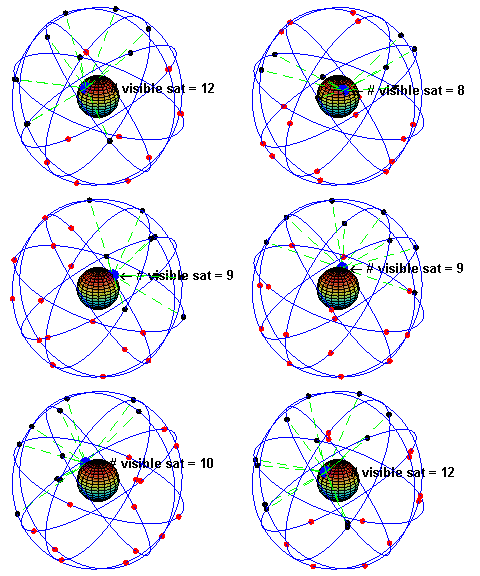
GPS Constellation

A visual example of the GPS constellation in motion with the Earth rotating. Notice how the number of satellites in view from a given point on the Earth's surface, in this example at 45°N, changes with time.

This is default featured slide 5 title

Go to Blogger edit html and find these sentences.Now replace these sentences with your own descriptions.This theme is Bloggerized by Lasantha Bandara - Premiumbloggertemplates.com.

Showing posts with label Public Health. Show all posts

19.3.12

Pelatihan GIS untuk Kesehatan Masyarakat oleh CDU dan Amarilys

Minggu kemarin sejak senin sampai kamis (12-15 Maret 2012) saya mengikuti pelatihan yang di laksanakan oleh Amarilys (sebuah perkumpulan yang anggotanya para dokter yang berdedikasi tinggi dalam pelayanan kesehatan di Indonesia).

Pelatihan ini menggunakan opensource software. Pelatih utama pelatihan ini adalah Rohan Fisher dari Charles Darwin University (CDU) – Australia. Materi yang disampaikan sangat berguna apalagi Openjump (software GIS gratis) yang digunakan memiliki kelebihan dapat menampilkan chart pada peta hasil olah. Walaupun pelatihan ini temanya untuk kesehatan masyarakat, setelah selesai saya yakin ini bisa digunakan di ranah penanggulangan bencana yang sedang saya geluti.


Perkenalan dengan pemetaan kesehatan

Materi ini dibuka dengan pemutaran film pemaparan keberhasilan John Snow dalam pemecahan kasus kolera di London tahun 1754. Pemecahan itu melalui pemetaan, sehingga distribusi penyakit bisa diketahui dan juga apa penyebabnya. Penyebabnya adalah penggunaan air dari pompa yang tercemar.


Perkenalan dengan Sistem Informasi Geografis

GIS tidaklah mahal, GIS tidaklah sulit, GIS adalah menyenangkan. Itulah kesimpulan yang saya ambil dari materi kali ini. Kenapa? Karena:

1. Kita tidak perlu menggunakan sotware GIS yang mahal, gunakan saja yang gratisan misalnya OpenJump, openStreet, EpiMap dll. Biar gratis bukan hasil bajakan loh.
2. Dengan menggunakan Software ini, saya saja yang tidak memiliki background gis bisa menggunakannya.
3. Menyenangkan? Tentu ! karena dari input, proses sampai hasil sangat membuat kita mengembangkan diri dan santai.

Kita bisa menggunakan software SIG yang opensource jadi gratiskan, hasilnya? Tetap saja bagus bahkan karena bisa membuat chart maka bisa lebih berbicara dari selembar peta saja.

Bagaimana menggunakan OpenJump? Sabar yah nanti saya coba dulu di ranah kebencanaan dan bila sudah jadi maka saya share ...


Share Me


Silahkan memberikan komentar anda mengenai tulisan ini disini, atau di boks dibawah tulisan ini, terima kasih.

View My Profile on View ujang lasmana's profile on LinkedIn

GPS murah di sini, kontak: tracknavigate[at]yahoo[dot]com

7.4.11

Masyarakat Indonesia Harus Belajar Pertolongan Pertama

Letak geografis Indonesia yang berada di sabuk gunung api, menyebabkan Indonesia rawan terhadap bencana. Ancaman gunung berapi, gempa bumi, tsunami, dan longsor membayangi rakyat Indonesia. Berdasar data BMKG, setiap hari pasti terjadi gempa baik diatas 5SR maupun di bawah 5SR.

Luka merupakan dampak yang umum terjadi disaat bencana terjadi. Bila luka tersebut tidak segera ditangani dengan benar maka kefatalan bisa saja terjadi.

Bertolak dari kondisi ini, diharapkan masyarakat Indonesia dibekali dengan keterampilan Pertolongan Pertama. Memang pemerintah sudah memiliki cukup banyak tenaga terlatih siaga bencana (bila saya hanya berpatokan pada kuantitas atau jumlah saja), namun kondisi geografis pulalah yang terkadang menyebabkan suatu daerah terisolasi akibat terputusnya akses menuju dan keluar dari daerah bencana. Bidan desa yang merupakan ujung tombak (dan memang ini terbukti) biasanya langsung bertindak memberikan pertolongan pertama, namun tetap saja waktu menjadi taruhannya.

Kondisi tertentu, menyebabkan korban bencana membutuhkan pertolongan yang segera, bila tidak adanya tenaga terlatih awam maka penyelamatan jiwa menjadi semakin jauh dari harapan.

Dengan diberikannya masyarakat pelatihan pertolongan pertama yang adekwat dan memenuhi persyaratan atau standar maka risiko kematian, kecacatan atau semakin bertambahnya keparahan menjadi berkurang.

Pelatihan Pertolongan Pertama bagi Masyarakat merupakan sebuah kebutuhan di daerah yang rawan bencana, living with risk harus diperkuat dengan keterampilan pertolongan pertama.▲


Silahkan memberikan komentar anda mengenai tulisan ini disini, atau di boks dibawah tulisan ini, terima kasih.

GPS murah di sini, kontak: tracknavigate[at]yahoo[dot]com

30.12.10

National Geographic Indonesia Edisi Spesial ”Perubahan Iklim” - "Changing Climate"

Semua telah terjadi. Gletser yang mencair, gelombang panas, naiknya permukaan laut, pepohonan berbunga lebih awal, danau yang membeku lebih lambat, burung-burung pengelana menunda penerbangannya ke selatan. Tanda-tanda perubahan iklim ada dimana-mana dan dunia di sekeliling kita berubah cepat. Pemanasan global juga paling berdampak pada berbagai spesies di kutub. Berkurangnya es di laut secara khusus menjadi tanda bahaya bagi beruang kutub yang bergantung pada lempeng es untuk berburu, beristirahat, dan bepergian. Relita pun semakin jelas. Kita takan mamapu memperbaiki habitat satwa itu. Kita tidak dapat memutar waktu ke belakang”. Demikian essay pada foto awal Majalah National Geographic edisi khusus Perubahan Iklim versi Indonesia dengan penekanan pada "Apa yang Harus Kita Ketahui, Apa yang Bisa Kita Lakukan".

Perubahan musim merupakan hal yang paling nyata saat ini. Saat saya masih sekolah dulu diajarkan bahwa musim penghujan di Indonesia ada pada bulan-bulan yang berakhiran ber-ber, dan itu memang benar. Teringat aku dengan lagu Mbak Vina Panduwinata yang berjudul “September Ceria”, yang secara umum menceritakan betapa senang dan indahnya hati ini dengan datangnya musim hujan mengakhiri musim kemarau.

Sehingga dekade lalu membuat kita mudah merencanakan kegiatan keluarga, namun kini? Ambillah contoh sederhana, seorang biker (soalnya saya biker juga hehehe) kini harus membawa jas hujan sepanjang tahun di motornya padahal spacenya terbatas. Karena pada musim-musim panas-pun kini sering terjadi hujan yang kejadiannya tiba-tiba dan dengan curah hujan yang besar (deras). Cuaca sudah tidak bisa diprediksi lagi.

Kembali ke majalah National Geographic edisi khusus ini. Majalah ini membagi bab menjadi tiga bagian, agar pembaca lebih memahami perubahan iklim dan dampaknya pada kehidupan kita. Bab pertama pada halaman delapan berjudul “Tanda Perubahan”, bagian ini memaparkan tanda-tanda nyata perubahan iklim. Menurut saya sebenarnya janganlah kita menanyakan dan mencari bukti tentang perubahan iklim sehingga membuat kita terlambat mengantisipasinya, bila tanda-tanda itu telah terlihat oleh mata maka kita sudah terlambat.

Bab kedua yang hadir di halaman 26 berisikan tentang bukti-bukti berdasarkan sains, dimana teori-teori bermunculan dan juga teori lain bertumbangan. Judul bab ini adalah “Sains”.

Lantas bab terakhir berisikan solusi-solusi sederhana yang dapat dilakukan dirumah dan tempat kerja untuk memitigasi dan beradaptasi terhadap perubahan iklim, bab ketiga ini berjudul “Solusi” dan hadir di halaman 52.

Dipenuhi foto-foto berkelas tinggi ciri khas National Geographic membuat pemahaman kita semakin mudah. Dan juga ditambah bonus “Poster Panduan Rumah Hijau” membuat semakin bermutunya bahan bacaan kita kali ini. Secara pribadi saya sering menjadikan artikel-artikel National geographic sebagai rujukan dalam pekerjaan saya di ranah “Disaster Risk Reduction”, saya teringat dengan artikel tentang melacak jejak gempa di barat sumatera, kerifan lokal masyarakat di berbagai gunung berapi (misalnya Merapi dan Bromo) di Indonesia yang memiliki potensi untuk meningkatkan kewaspadaan dan kesadaran masyarakat terhadap upaya pengurangan risiko, visi masa depan rumah tahan gempa dan juga artikel yang mengulas tentang kehidupan dan warisan pemikiran Jughun yang bisa dijadikan sumber dalam melakukan mitigasi hijau di daerah rawan bencana.

Majalah ini hadir dengan berbagai bahasa termasuk bahasa Indonesia, untuk yang edisi bahasa Indonesia dan diterbitkan oleh NatGeo Indonesia di jual dengan harga Rp. 75.000,- tidak terlalu mahal untuk mendapatkan ilmu.


Silahkan memberikan komentar anda mengenai tulisan ini disini, atau di boks dibawah tulisan ini, terima kasih.

GPS murah di sini, kontak: tracknavigate[at]yahoo[dot]com

30.7.09

Lacak Flu Babi, Anak SD Dibekali Ponsel Ber-GPS (GPS for Students for H1N1 surveillence)

Sebanyak 1.000 murid SD di Jepang akan dibekali ponsel ber-GPS. Rencana percobaan ini merupakan gagasan dari pemerintah Jepang dan salah satu operator mobile, Softbank.

Untuk apa anak-anak SD di sana dibekali ponsel canggih? full sory Click here Alasan kesehatan ternyata menjadi tujuan rencana tersebut.

Dengan bantuan GPS, diharapkan penyebaran flu babi bisa dilacak dan dibatasi. Dikutip detikINET dari TechRadar, Senin (8/6/2009), data dari GPS akan digunakan untuk melacak pergerakan sejumlah anak-anak yang sebelumnya telah dipantau.

Data GPS juga dipakai guna mengetahui seberapa banyak anak-anak lain yang berpotensi terkena penyakit itu.

Jika data tersebut berhasil diketahui, akan lebih mudah untuk menyampaikan peringatan kepada mereka agar tetap berada di dalam ruangan dan mengurangi kontak dengan orang lain agar penyebaran tidak meluas.

Namun meski banyak manfaat yang dituai, tetap ada kecemasan di balik rencana ini. Hal tersebut terkait dengan hukum mengenai aksi pengawasan terhadap orang secara terus-menerus.
( sha / faw )

From: detik.com
Senin, 08/06/2009 17:20 WIB
Santi Dwi Jayanti - detikinet

2.7.09

(GPS on ERU Team Training) American Red Cross Builds International Disaster Response Skills


Recording a shelter location on a handheld GPS, preparing a disaster operation plan of action and then sending it via satellite phone, and dining on meals-ready-to-eat were just a few day-to-day realities of disaster responders—including an American Red Cross Relief Emergency Response Unit (ERU) member—in Peru last August.

"When the Red Cross or Red Crescent in another country asks for help, it's our responsibility to send people with the right preparation, skills and personal qualities ready to give immediate support," emphasized Tracy Reines, Director of International Disaster Response at the American Red Cross. "Field-based training is a key element of that preparation."

The American Red Cross has offered Relief ERU training since 2003—when the Relief ERU tool was launched—to enhance the skills of experienced disaster workers. This year, however, a new element was added to the training.

From April 20-26, the American Red Cross hosted its first joint Relief and IT & Telecommunications ERU training in Panama City, Panama.

"The Relief and IT & Telecommunications ERUs work closely together on disaster operations," said Travis Betz, Field Operations Officer for the American Red Cross, "bringing them together for this course creates a more realistic training environment and teaches collaboration, which is essential to a successful mission."

Many participants focused on relief—such as how to conduct assessments and coordinate distributions of relief supplies—while others concentrated on setting up and maintaining computer systems and emergency communications networks in the field. All participants learned how their work supports the local Red Cross or Red Crescent.

While the ERU training includes classroom discussions and presentations, it's the integrated, hands-on activities that add real value and distinguish the course from others.

"Our goal is to give participants a taste of the field," said Colin Chaperon, Field Operations Senior Associate. "Field exercises that simulate disasters allow participants to practice response skills, while showing patience, flexibility and resourcefulness required in these complex situations."

"The training was an incredible experience," confirmed Laura Hevesi, a participant in the training. "I know the lessons learned this past week, and there were many, will serve me for a long time to come."

As part of the largest humanitarian organization in the world, the American Red Cross never works alone internationally. This training was no different. The Danish Red Cross provided the curriculum and three facilitators for IT & Telecommunications portion. Last year, when the Danish Red Cross was forming its Relief ERU, the American Red Cross sent facilitators for their training. It's a classic case of sister societies helping each other out.

But partners aren't only sister national societies. Just as the American Red Cross relies on donor support during disasters like the Peru earthquake, donors also aid in preparing to respond.

When the American Red Cross had to send equipment—satellite phones, computers, hand-held radios, GPS, tents and cots—to Panama prior to the course, FedEx Corporation shipped our goods free of charge.

Three other donors—Delta Airlines, UPS and Daimler Financial—attended the course for two days as observers to learn just how in-depth and realistic the field-based course is.

"It was obvious that the Red Cross is a remarkably well-organized, experienced and professional organization that provides invaluable help to the community worldwide," commented Alice Benitez, a manager with UPS. "Equally remarkable was the human quality, dedication and passion of the individuals, both employees and volunteers, that were part of the training. Seeing it all come together in the field exercise was very inspirational."

From: http://www2.redcross.org/article/0,1072,0_332_7736,00.html

Gina Guinta, Information Analyst, American Red Cross

Friday, May 16, 2008

As part of the world's largest humanitarian network, the American Red Cross alleviates the suffering of victims of war, disaster and other international crises, and works with other Red Cross and Red Crescent societies to improve chronic, life-threatening conditions in developing nations. We reconnect families separated by emergencies and educate the American public about international humanitarian law. This assistance is made possible through the generosity of the American public.

1.7.09

GPS to improve ambulance response

Ambulance response times should get shorter now that a new global-positioning system has been put in place, making it easier for emergency dispatchers to get the closest ambulance to a medical emergency.

After a year of planning and intensive testing, the automatic vehicle-location system is operating in Metro EMS. Now, dispatchers at MetroSafe Communications can see, in real time, the location of every paramedic or emergency medical technician.

The system uses GPS technology that has been placed in every ambulance and paramedic fly-car to figure out what available unit is closest to a medical call being phoned in to the 911 center.

"We're trying to make things faster," said Dr. Neal Richmond, head of Metro EMS. "But not just get there fast, but get there smart."

With the help of the GPS locators, the computer can recommend which unit is closest and available.

Previously, medical personnel had to call in their ambulance locations. But that only provided a best estimate of where an ambulance might be at any time, leaving dispatchers to make an educated guess about where the closest ambulance to a call might be.

This system eliminates the guesswork, Richmond said.

Because of the GPS, dispatchers can now see icons on their computer screens that show the locations of the ambulance or fly-cars within 10 feet of the actual location. They can see if they are traveling on an interstate or stationed at their prescribed headquarters.

The computer automatically updates the locations every six seconds.
Because of that accuracy, that could shave seconds, or even minutes, off of response time, official say.

City officials invested $435,000 in the system, which was paid for in a capital allocation to EMS.

Richmond said that is about the cost of what the city would pay to put another ambulance in the system, but by spending the money this way, response times improve across the board.

Louisville is the first community in the commonwealth, and among the first large systems in the country, to start using this system.


Reporter Jessie Halladay can be reached at (502) 582-4081.


By Jessie Halladay • jhalladay@courier-journal.com • June 4, 2009

Ambulans PMI Kapan yah dilengkapi GPS biar pelayanan makin tepat waktu dan efisien dalam penggunaan BBM

62 (Indonesian) police patrol cars equipped with GPS

DENPASAR: Police patrol cars were equipped with global positioning systems (GPS) on Tuesday during an event overseen by Bali Police Chief Insp. Gen. Teuku Ashikin Husein.

Bali Police spokesman Sr. Comr. Gde Sugianyar said 62 police cars had been equipped with GPS to increase coordination among officers. The new system means officers can receive instant directions from headquarters.


"The GPS will enable police to respond faster and better, as called for by President Susilo Bambang Yudhoyono," he said, adding that the 62 patrol cars outfitted with the technology were assigned to Denpasar, Badung, Gianyar and Tabanan - regencies with the highest crime rates.

Sugianyar said the patrol cars would also their gas tanks expanded by 10 to 20 liters to increase their range. - JP

From: http://www.thejakartapost.com/news/2009/02/04/62-police-patrol-cars-equipped-with-gps.html
Wed, 02/04/2009 3:56 PM | Bali

20.5.09

Global Positioning System: Significant Challenges in Sustaining and Upgrading Widely Used Capabilities


The Global Positioning System (GPS), which provides position, navigation, and timing data to users worldwide, has become essential to U.S. national security and a key tool in an expanding array of public service and commercial applications at home and abroad. The United States provides GPS data free of charge. The Air Force, which is responsible for GPS acquisition, is in the process of modernizing GPS. In light of the importance of GPS, the modernization effort, and international efforts to develop new systems, GAO was asked to undertake a broad review of GPS. Specifically, GAO assessed progress in (1) acquiring GPS satellites, (2) acquiring the ground control and user equipment necessary to leverage GPS satellite capabilities, and evaluated (3) coordination among federal agencies and other organizations to ensure GPS missions can be accomplished. To carry out this assessment, GAO's efforts included reviewing and analyzing program documentation, conducting its own analysis of Air Force satellite data, and interviewing key officials.


It is uncertain whether the Air Force will be able to acquire new satellites in time to maintain current GPS service without interruption. If not, some military operations and some civilian users could be adversely affected. (1) In recent years, the Air Force has struggled to successfully build GPS satellites within cost and schedule goals; it encountered significant technical problems that still threaten its delivery schedule; and it struggled with a different contractor. As a result, the current IIF satellite program has overrun its original cost estimate by about $870 million and the launch of its first satellite has been delayed to November 2009--almost 3 years late. (2) Further, while the Air Force is structuring the new GPS IIIA program to prevent mistakes made on the IIF program, the Air Force is aiming to deploy the next generation of GPS satellites 3 years faster than the IIF satellites. GAO's analysis found that this schedule is optimistic, given the program's late start, past trends in space acquisitions, and challenges facing the new contractor. Of particular concern is leadership for GPS acquisition, as GAO and other studies have found the lack of a single point of authority for space programs and frequent turnover in program managers have hampered requirements setting, funding stability, and resource allocation. (3) If the Air Force does not meet its schedule goals for development of GPS IIIA satellites, there will be an increased likelihood that in 2010, as old satellites begin to fail, the overall GPS constellation will fall below the number of satellites required to provide the level of GPS service that the U.S. government commits to. Such a gap in capability could have wide-ranging impacts on all GPS users, though there are measures the Air Force and others can take to plan for and minimize these impacts. In addition to risks facing the acquisition of new GPS satellites, the Air Force has not been fully successful in synchronizing the acquisition and development of the next generation of GPS satellites with the ground control and user equipment, thereby delaying the ability of military users to fully utilize new GPS satellite capabilities. Diffuse leadership has been a contributing factor, given that there is no single authority responsible for synchronizing all procurements and fielding related to GPS, and funding has been diverted from ground programs to pay for problems in the space segment. DOD and others involved in ensuring GPS can serve communities beyond the military have taken prudent steps to manage requirements and coordinate among the many organizations involved with GPS. However, GAO identified challenges in the areas of ensuring civilian requirements can be met and ensuring GPS compatibility with other new, potentially competing global space-based positioning, navigation, and timing systems.

For more documents:
Full Report:
http://www.gao.gov/new.items/d09670t.pdf
Highlight page: http://www.gao.gov/highlights/d09670thigh.pdf

16.5.09

Participatory Photo Mapping (PPM)


Departemen kedokteran keluarga, Universitas Wisconsin, Sekolah Kedokteran dan Kesehatan Masyarakat melakukan sebuah pendekatan untuk mengkomunikasikan dan mengeksplorasi pengalaman kesehatan pada masyarakat yang nantinya bisa digunakan untuk advokasi. Pendekatan itu bernama Pemetaan Foto Partisipatif (Participatory Photo Mapping).

Tujuan mereka adalah: to use PPM to develop and design collaborative projects and networks to improve health and well-being of communities by strengthening health information systems and sharing that information with community members and [public health] decision-makers.


PPM ini menggunakan fotografi, GPS dan GIS/foto udara dan FGD dalam pelaksanaannya.
Dengan PPM maka kita dapat:

1. mengkaji baik masyarakat dan juga lingkungan yang berkontribusi terhadap kesehatan, keselamatan, gizi dan well-being.
2. mengetahui persepsi masyarakat terhadap lingkungannya.
3. mengidentifikasi faktor-faktor lingkungan yang berdampak pada aktivitas fisik.
4. mengidentifikasi dukungan lingkungan, jejaring sosial dan hambatan-hambatan terhadap kesehatan
5. mempresentasikan informasi yang didapat kepada pemangku kepentingan, dan pengambil keputusan.

Langkah-langkah dalam PPM
1: Bekali peserta/masyarakat yang terlibat dengan kamera digital dan GPS, dan minta mereka memfoto daerahnya, kegiatan-kegiatan sehari-hari yang dilakukan masyarakat, baik yang mendukung kesehatan maupun yang tidak. Minta masyarakat mengambil koordinat obyek yang difoto, dan juga data-data demografi. Akan lebih baik bila menggunakan kamera yang langsung terkoneksi dengan GPS.
2: Nah foto-foto yang didapat dijadikan bahan diskusi pada FGD. Tayangkan foto-foto di layar atau dinding dan fasilitasi masyarakat mengomentari foto-foto tersebut dan gali persepsi mereka terhadap lingkungannya.
3: Dengan adanya geokode pada foto hasil dari pengambilan koordinat di GPS maka ini menjadi PGIS yang di dalamnya terdapat data demografi dan data spasial, seperti populasi, karakteristik rumah tangga, bahkan statistic criminal. Ini nantinya dijadikan GIS kualitatif berdasarkan pengalaman masyarakat dan lingkungannya.
4: Gunakan sebagai alat komunikasi kepada pengambil keputusan, seperti profesi kesehatan, pengusaha, organisasi masyarakat (LSM), Badan kemanusiaan dan pembuat kebijakan.

Sumber: http://www.fammed.wisc.edu/research/external-funded/communities-risk/ppm

12.2.09

Manfaatkan GPS Tracking dalam Manajemen Bencana/ GPS Tracking in Disaster Management


Dalam manajemen bencana, terutama dalam tahap tanggap darurat dan rehabilitasi/rekonstruksi, ketepatan bantuan baik terhadap penerima manfaat (beneficiaries) maupun dari sisi efisiensi haruslah menjadi pertimbangan utama. Buat apa melibatkan banyak orang hebat di bidang tanggap darurat, namun keteteran dalam hal manjemen.


Lebih baik menurunkan sedikit jagoan tersebut, sambil para jagoan lain yang tidak ditugaskan terus dalam kondisi siaga – maklum Indonesia rawan bencana, namun target tercapai.


Untuk kecepatan menanggapi suatu kondisi darurat, mungkin kita bisa belajar dari Bulan Sabit Merah Palestina dan Kristal Merah Israel.


Kedua Perhimpunan Nasional ini memanfaatkan GPS tracking dalam memberikan pelayanan ambulans bagi masyarakat di Palestina dan Israel, baik disaat “damai” maupun disaat konflik bersenjata seperti beberapa waktu yang lalu.


Bagaimana yah cara kerjanya GPS tracking itu?


Paling ngga begini (maklum saya bukan ahlinya)
GPS tracking dapat menunjukkan dimana posisi armada (misalnya PMI) PMI, ini bisa dilihat dilayar komputer yang terhubung dengan Google Earth. Jadi kita bisa memantau dan menggerakan armada mana yang dekat atau paling mudah mendapatkan akses ke suatu tempat pelayanan. Juga memilih jalur mana yang bisa dilalui dan disarankan. Terutama ini demi menjaga keselamatan tim bantuan.


Nah, pengatur perjalanan yang ada diposko bisa dengan ,mudah memantau posisi melalui komputer yang terhubung dengan internet dan sudah diinstalasi dengan program dukungan tentunya. Jadi melalui radio dia bisa mengontak pak supir untuk menggerakan armadanya ke suatu tempat.


Jadi tim dilapangan bisa terhindar dari hambatan, gangguan pokoknya aman deh. Jadi bisa pulang kerumah dengan aman, dan menemui anak-anak tersayang (so pasti isteri atau suami loh).


GPS tracking yang bisa digunakan diantaranya adalah GPS Tracking GEA-01 dan GPS Tracking GPT 02 (Personal Tracker), yang terkahir ini untuk anggota tim.


GPS ini dipasang di Ambulans misalnya, dan nanti tinggal pantau posisinya di komputer, apalagi bisa dilihat di Google Earth, makin jelas deh.


Berikut ini fitur dan spek dari keduanya (diambil dari http://indogeotech.com/product/view/20090210204159/GPS-Tracking-GEA-01.html dan http://indogeotech.com/product/view/20090210205525/GPS-Tracking-GPT-02--Personal-Tracker-.html


GPS Tracking GEA-01:

Fitur:

Functions :


Locating the coordinate of the target vehicle by receive GPS satellite signal

Monitoring the vehicle via control centre by GSM network communication

Send emergency alarm to the monitoring center while the vehicle appears emergency

Remotely shut off the oil and electricity of the vehicle when the stealing is appeared

Support blind signal area offset while the vehicle can not be covered with GPS signal

Built-in lithium battery, terminal can work for 15-20 hours when the external power is cut off

The terminal unit will be turned off by itself when the working voltage is too low

Support point to point control, point to group control, group to group control, the entire control process will be achieved automatically

Can be connected to PDA Laptop or Smart Phone for vehicle navigation

Without any monthly rent for using


Product's Spesification:

Dimension 100 x 60 x 18 mm

Weight 92 g

External power supply DC 9V~36V(DC12V)

Battery charge time 2 hours

Power consumption 55mA

GPS Chipset NEMERIX

GPS antenna External GPS antenna

GPS tracking Software Developed by manufacturer

Position Accuracy 3~5 m

Information feedback time <120 sec, the least <20 sec

GPS Start Time Cold: 30~45 Sec, Warm: 15~25 Sec, Hot: 5~8 Sec

GSM frequency range 900/1800 MHZ

GPS frequency range 1575.42 MHz

GPS Communication range The entire opening area towards to the sky

GSM/GPRS network communication speed 9600 bps

Picture transmission speed 3 frames per sec.

Working temperature Mainframe: 20°C~55°C

Date Cable: d85°C

GPS receiving antenna: -30°C~75°C


GPS Tracking GPT 02 (Personal Tracker)

• Real-time view the terminal objects on Google Earth

* Locate position of the targets (person or animal) by sending a SMS

* Send emergency alarm to the pre-assigned cell phone

* Make a phone call to the pre-assigned cell phone directly

* Set up a GEO fence for limiting the action scope of the terminal

* Over speed alarm

* SMS communication or GPRS TCP/UDP connection


* Support GSM band 850/900/1800/1900 MHZ

* High sensitivity, with SiRF-Star III GPS chipset

* Excellent GPS signal receiving ability, even at a weak signal area

* Smart shape, very easy to hold (Dimension: 76*45*20mm, Weight: 70g)

* Adopted common NOKIA cell phone battery, you can use a backup battery easily

* Support continuously tracking, report the location of the object by a time interval

* SOS direct call, just need to simply press a button

* SOS alarm by SMS

* Simply track a person without bothering

* Optional solar battery, can charge the tracker everywhere

* Optional water-proof case and pet collar, provide you more choices


21.10.08

About the Public Health Mapping and GIS programme

Origins and rapid evolution

The Public Health Mapping and Programme was originally developed by WHO and UNICEF in 1993 to boost efforts to eradicate guinea worm disease, which affects the isolated, rural poor, through the use of GIS. The system allows the computer-assisted visualization of disease foci, the monitoring of newly infected or reinfected villages, the identification of at-risk populations, and the highly targeted, cost-effective distribution of interventions. It is an example of how technologies developed to accelerate the control of one disease can expedite the control of others.

Since then the use of GIS and mapping have been greatly simplified and expanded to meet the distinct data needs of several disease control initiatives, including programmes for the elimination of onchocerciasis, blinding trachoma, African trypanosomiasis and lymphatic filariasis, as well as the global initiatives to eradicate poliomyelitis and roll back malaria.

The Public Health Mapping Partnership today

The Public Health Mapping and GIS Programme has now become a global partnership involving WHO Regional and Country Offices, WHO Member States, infectious disease programmes, UN agency and bliateral partners, research institutes, WHO collaborating centres and the private sector.

The programme operates operates through a wide partnership at country, regional and global levels. A WHO Public Health Mapping network has been established comprising focal points from WHO regions and country offices. In addition a public health mapping user network has been established involving public health administrators from over 80 countries who are working on public health mapping initatives at national and sub-national levels.

The partnership has a key role to play in the work of WHO by:
• advising national ministries of health in the design and implementation of GIS and related technologies in support of public health programmes;
• providing a core set of services and products relating to GIS and mapping;
• assisting countries in the development of core geographic datasets including the mapping of communities and health care;
• developing collaborative operational research projects based on new GIS related technologies with research institutes and private industry.

28.9.08

GIS for public health

Geographic information systems and remote sensing have capabilities that are ideally suited for use in infectious disease surveillance and control, particularly for the many vector-borne neglected diseases that are often found in poor populations in remote rural areas. They are also highly relevant to meet the demands of outbreak investigation and response, where prompt location of cases, rapid communication of information, and quick mapping of the epidemic’s dynamics are vital. However, until recently, the use of these tools in public health were largely limited in use due to two major problems: the prohibitive cost of hardware and the great complexity of GIS software that made it extremely time-consuming as well as costly to extract information relevant to the practical demands of disease prevention and control.

The situation has changed dramatically over the past few years. Hardware prices have plummeted, simple new devices are now available, and a new generation of civilian satellites is in orbit, circling the world. The Public Health Mapping and GIS programme, based within WHO Communicable Diseases, has been developed with the goal of providing greater access to simple, low-cost geographic information and related data management and mapping systems to public health administrators at all levels of the health system.

Uses of GIS in public health

• Determining geographic distribution of diseases
• Analysing spatial and temporal trends
• Mapping populations at risk
• Stratifying risk factors
• Assessing resource allocation
• Planning and targeting interventions
• Monitoring diseases and interventions over time
Just as satellites and the Internet led to an explosion of information, these technologies are making it possible to acquire high-quality epidemiological data with a precision and speed that could not have been imagined a decade ago.

http://www.who.int/health_mapping/gisandphm/en/

25.9.08

Risk Mapping and Prediction of Neglected Tropical Diseases

Risk Mapping and Prediction of Neglected Tropical Diseases

Neglected tropical diseases are pervasive in rural communities of resource-constrained countries and they are intimately linked with the lack of clean water and adequate sanitation, and hence poverty-promoting. An important epidemiological feature of the neglected tropical diseases is their focal distribution. In order to target limited resources for control in a cost-effective manner, our research aims to develop new approaches for prediction and mapping of high-risk areas to guide spatial targeting of control interventions.

For the mountainous region of Man in western CĂ´te d’Ivoire, we were able to predict high-risk areas for Schistosoma mansoni, using a diversity of data sources (i.e. demographic and socio- economic data derived from questionnaire surveys, and environmental features obtained from remotely-sensed satellite sensors) and Bayesian variogram models. A digital elevation model was developed to characterise rivers according to the stream order and to delineate catchment areas. The data were incorporated into a geographical information system (GIS) and spatially-explicit analysis found highly significant associations between the prevalence of S. mansoni at the unit of a school and stream order and catchment area. Hence, these two hydrological features were good predictors for mapping the high-risk areas of S. mansoni. In a next step, risk maps for hookworm infections were generated, using the same data sources. Bivariate analysis showed that sex, age, socio-economic status, elevation, rainfall and land cover were significantly associated with the spatial distribution of hookworm infection, but spatial correlation depended only marginally on the location. Next, we predicted high-risk areas for S. mansoni-hookworm co-infections. Significant risk factors for a co-infection were age (children aged 11-16 years were at a higher risk than their younger counterparts, sex (boys were at a higher risk than girls), altitude (schools located below 400 m above sea level were at higher risk than schools at higher altitudes) and socio-economic status (poorer households were at higher risk than better-off households). Our integrated risk profiling approach holds promise for prediction and mapping of other neglected tropical diseases. In a next step, we aim to predict infection intensities of single and multiple species parasitic infections, including malaria.

http://www.sti.ch/research/public-health-and-epidemiology/ecosystem-health-sciences/risk-mapping-and-prediction-of-neglected-tropical-diseases.html

Another Articles

Ready to Download

Silahkan Unduh Manual dibawah ini, bila dijadikan referensi mohon dicantumkan sumbernya.

Manual Mahir Memanfaatkan Peta Navigasi.net untuk Garmin Map 76 CSx, ETrex Vista HCx dan Nuvi Series dalam 30 Menit

Manual singkat yang berisikan langkah-langkah Instalasi dan memanfaatkan peta navigasi.net untuk GPS Garmin Map 76 CSx, ETrex Vista HCx dan Nuvi Series


Manual Mahir Garmin Map 76 CSx dalam 30 Menit

Manual singkat yang berisikan langkah-langkah penggunaan GPS Garmin Map 76 CSx


Manual Garmin HCx untuk Pemetaan Risiko Bencana

Manual yang berisikan langkah-langkah penggunaan GPS Garmin HCx untuk memetakan risiko bencana, dan juga berisi bagaimana mengolah data di MapSource setelah mendapatkan data GPS


Daftar Legenda dalam Pemetaan Risiko Bencana

Berisikan legenda-legenda yang ada dalam manual SIGaP untuk Pemetaan Risiko digunakan dalam memetakan risiko bencana


Daftar Kebutuhan Pemetaan Risiko Bencana

Daftar yang berisikan keperluan-keperluan pemetaan risiko bencana yang biasa digunakan oleh PMI


Daftar Istilah dalam Pemetaan Risiko Bencana

Berisikan istilah-istilah yang ada dalam manual SIGaP untuk Pemetaan Risiko digunakan dalam memetakan risiko bencana


Kamus SIGaP/ Dictionary of PGIS

Berisikan istilah-istilah yang digunakan dalam Sistem Informasi Geografis Partisipatif, keluaran PPGIS/IAPAD


Diagram Alur Pemetaan Risiko Bencana

Diagram alur pemetaan risiko bencana yang biasa digunakan oleh PMI


Formulir Hazard

Formulir Hazard/Ancaman yang biasa digunakan oleh PMI


Formulir Isian

Formulir Isian dalam pemetaan risiko yang biasa digunakan oleh PMI


Daftar di bawah ini merupakan Bab-bab yang ada dalam Buku Manual Sistem Informasi Geografis Partisipatif (SIGaP): Pemetaan Risiko yang dilakukan secara Partisipatif

Bab 2: GPS

Bab 2 dari buku Manual SIGaP untuk Pemetaan Risiko, yang merupakan buku pertama dalam rangkaian buku Pemetaan Risiko. Berisikan dasar-dasar GPS dan hubungannya dengan Risiko Bencana


Bab 4: Analisa Data

Bab 4 dari buku Manual SIGaP untuk Pemetaan Risiko, yang merupakan buku pertama dalam rangkaian buku Pemetaan Risiko. Berisikan bagaimana menganalisa data yang sudah didapat dalam pemetaan di lapangan oleh Sukarelawan PMI


Bab 5: Membuat Peta Tumpang Susun/Overlay, Peta Dinding, dan 3 Dimensi

Bab 5 dari buku Manual SIGaP untuk Pemetaan Risiko, yang merupakan buku pertama dalam rangkaian buku Pemetaan Risiko. Berisikan bagaimana membuat peta tumpang susun, peta dinding, dan peta 3 Dimensi. Langkah ini merupakan langkah berikutnya setelah pengolahan data dengan MapSource


Bab 6: Google Earth

Bab 6 dari buku Manual SIGaP untuk Pemetaan Risiko, yang merupakan buku pertama dalam rangkaian buku Pemetaan Risiko. Berisikan dasar-dasar pemanfaatan Google Earth dalam pemetaan Risiko

Ready Downloaded List: Mapping Software

Download Google Earth
Google Earth Versi 6.2

Unggah Google Earth versi terbaru


Download MapSource Mutakhir MapSource software version 6.16.3

Tingkatkan MapSource anda dengan piranti lunak MapSource terbaru dari sumber aslinya


Up Date software unit Garmin Anda Up Date Software Garmin Anda

Tingkatkan Performa GPS Receiver Garmin anda dengan piranti lunak dari sumber aslinya

Reader